
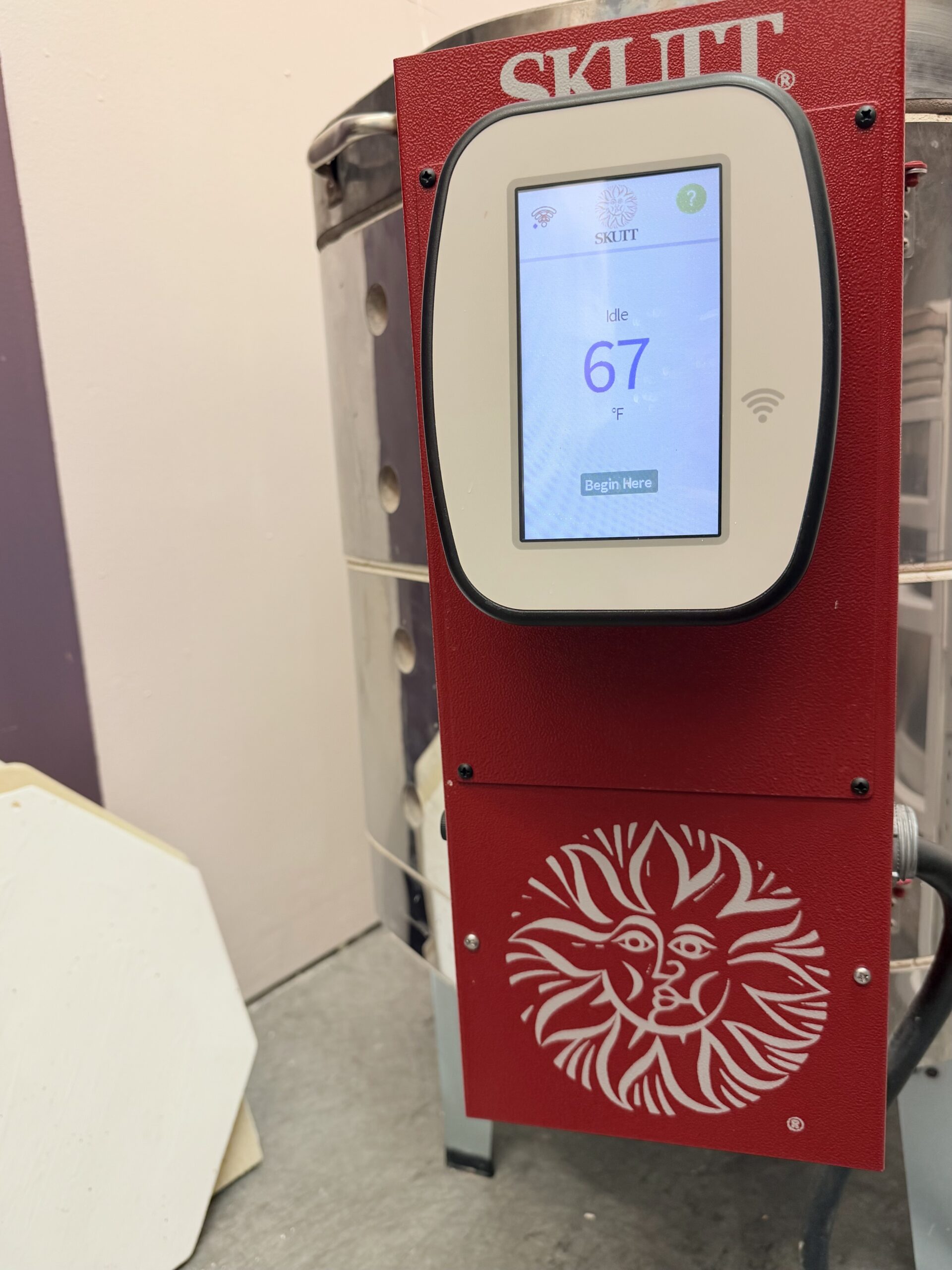
Have you ever placed a bone dry piece of greenware in the kiln and wondered what actually happens inside? Watching a piece transform from fragile, mud into a strong, durable ceramic feels almost like magic. But it’s really a series of fascinating physical and chemical changes happening step by step as the temperature rises.
Firing is more than drying. It’s a permanent transformation. Once clay is fired, it will never return to mud. Every stage in the kiln shapes your piece into something strong, beautiful, and lasting.
Before the Kiln: Dry Clay Is Essential
Before firing begins, the clay must be completely bone dry. Even when it feels dry to the touch, clay still holds two types of water:
- Physical water sitting between particles, which behaves like tiny droplets trapped in the clay.
- Chemical water that is bound within the clay minerals themselves, like water woven into the clay’s very structure.
As the kiln reaches 212°F (100°C), the physical water turns to steam. Steam expands quickly and can create pockets of pressure inside the clay. If the water cannot escape slowly, the clay cracks or even explodes. That’s why careful drying and slow initial heating are so important.
Bisque Firing: Where Clay Becomes Ceramic
Bisque firing usually reaches temperatures between cone 06 and cone 04, about 1828°F to 1945°F (998°C to 1063°C). But the transformation happens gradually in stages long before the peak temperature.
1. Removing Remaining Moisture
Room temperature to 212°F (100°C)
At the beginning of firing, any leftover physical water evaporates. Heat gently coaxes the water out, allowing it to escape as steam. If heated too quickly, the steam builds up and can crack the clay, especially in thicker areas.
Up to this stage, the clay is still clay, soft in a molecular sense, but fragile and ready to begin its transformation.
2. Burning Out Organic Material
300°F to 700°F (150°C to 370°C)
Clay isn’t pure earth. It contains tiny fragments of plants, roots, or leftover organic matter. As the kiln heats up, these materials burn away, releasing gases that need to escape.
You might notice a faint earthy smell during this stage. That’s the carbon from organic matter disappearing. Proper ventilation prevents trapped gases that can cause tiny bubbles or weak spots later in the firing process.
3. Losing Chemically Bound Water
896°F to 1112°F (480°C to 600°C)
Now comes a dramatic change. The water that is chemically bound inside the clay minerals begins to leave. This process is called dehydration.
- The clay’s molecular structure is permanently altered.
- The material becomes ceramic for the first time.
- It will never dissolve in water again.
Imagine the clay as a network of tiny scaffolding. The water that leaves is part of the scaffold itself. Once it’s gone, the structure is permanently set.
4. Quartz Inversion
1063°F (573°C)
Most clay contains quartz, a form of silica. Quartz changes its crystal structure at 1063°F, expanding slightly when heated and contracting again as it cools.
This sudden expansion and contraction can put stress on the clay. If the kiln heats or cools too quickly through this stage, cracks can form. This is why controlled heating and cooling are so important.
Think of quartz like tiny springs inside your clay. They need gentle transitions to avoid breaking the structure.
5. Inorganic Material Burnout
1292°F to 1652°F (700°C to 900°C)
At higher temperatures, certain minerals in the clay break down, releasing additional gases. Sulfur compounds, carbonates, and other impurities burn out during this stage.
If gases become trapped because of poor ventilation or too-rapid firing, they can form bubbles, pinholes, or weak areas in the clay.
6. Sintering: Particles Bond Together
As the temperature rises past 1100°F (600°C), clay particles begin to fuse. This process is called sintering.
- The particles pull closer together and stick.
- The clay becomes denser, stronger, and more solid.
- It is still porous enough to absorb glaze, but much less fragile than greenware.
Imagine tiny hands linking together inside the clay, holding each particle in place and creating a stronger whole.
7. Mineral Changes and Mullite Formation
Some minerals don’t just lose water, they change or decompose, creating new structures inside the clay.
- Mullite crystals form in stoneware and porcelain between 1922°F and 2012°F (1050°C to 1100°C).
- Mullite adds strength, durability, and heat resistance to the finished ceramic.
These changes happen invisibly, deep inside the clay body, giving the ceramic its resilience and stability.
Vitrification: The Glass Phase
After bisque firing, the clay is still somewhat porous. Higher temperatures continue the transformation.
- In stoneware and porcelain, fluxes like feldspar begin melting.
- Silica forms a glass phase that fills the pores between particles.
- This process is called vitrification.
As vitrification increases, the clay becomes denser, stronger, and less absorbent. Some high-fire porcelain can even hold water without glaze.
Cooling Matters Too
Firing is not complete when the kiln shuts off.
- As the clay cools, quartz contracts again.
- Rapid cooling can cause cracks, known as dunting.
- Slow, controlled cooling protects the finished work.
Firing is a journey, both up and down. Each stage matters.
From Mud to Ceramic
When you start, you have soft, wet clay that can dissolve in water.
After firing, you have ceramic that is:
- Hard and durable
- Strong and dense
- Permanent and lasting
The changes inside the kiln include:
- Water evaporation and chemical dehydration
- Organic and inorganic burnouts
- Quartz expansion and contraction
- Particle bonding and sintering
- Glass formation and crystal growth
Every kiln opening is a chance to witness transformation in action, turning earth into something enduring.
Ready to See the Transformation for Yourself?
Understanding what happens inside the kiln changes how you approach every stage of making. When you know how heat strengthens, bonds, and matures your clay, you work with more confidence and fewer surprises.
If you’re ready to deepen your skills, join us in the studio for a handbuilding class or open studio session. Let’s turn mud into something lasting together.
Explore upcoming workshops and studio time at Potterings and start your next firing with confidence.