
You made something with your own hands.
Maybe it’s a mug you’re already imagining using with your morning coffee. Maybe it’s a bowl for your kitchen table or a gift for someone you love.
Now comes the part that feels a little scary.
Firing your own pottery.
For a lot of potters, this is where confidence disappears. You’ve spent hours building and glazing your piece, and the thought of putting it into a kiln can feel overwhelming. What if it cracks? What if the glaze runs? What if you press the wrong button?
If that’s where you are, you’re not alone.
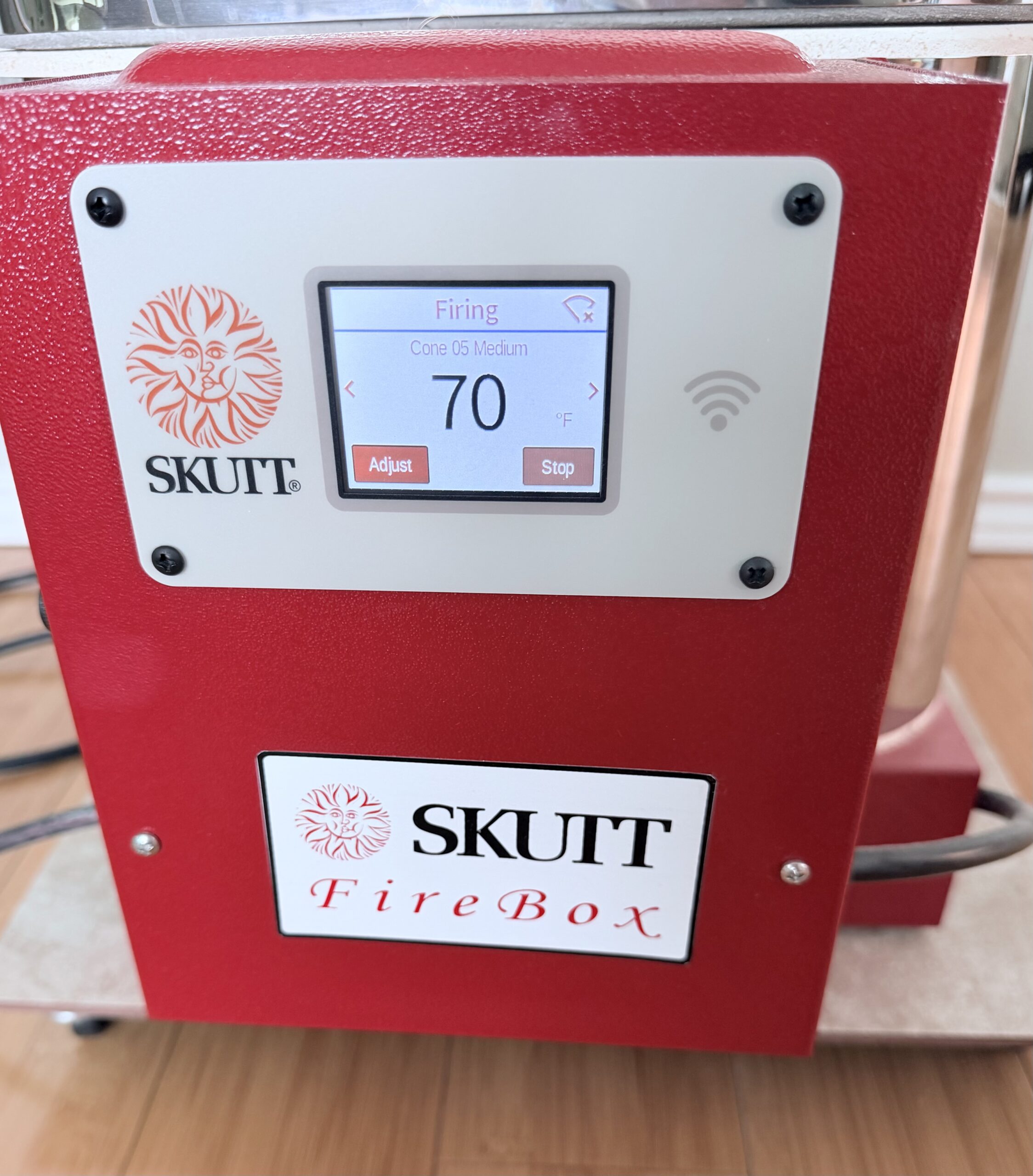
The good news is you don’t need a giant studio or years of experience to start firing pottery at home. The Skutt Firebox 8×6 was designed for people just like you. It plugs into a regular household outlet, fits in a small workspace, and makes home firing surprisingly approachable.
At Potterings, we use our Firebox for glaze testing, experimenting with new ideas, and firing small projects. It’s become one of our favorite studio tools because it lets us try something new without waiting for a full kiln load. Our main studio kiln is the Skutt 818, a perfect size for our pottery experience studio.
If you’re thinking about bringing pottery home, this little kiln is a wonderful place to begin.
Why the Firebox Makes Sense for Beginning Potters
Every potter reaches the same crossroads.
You love making pottery, but depending on someone else’s kiln means waiting days—or even weeks—to see the finished result.
Owning your own kiln changes that.
Instead of wondering when you’ll get your work back, you decide when it’s ready. You can test a new glaze on Tuesday, fire it on Wednesday, and be holding the finished piece by the weekend.
That’s freedom.
The Skutt Firebox removes one of the biggest barriers to owning a kiln: electricity.
Unlike most ceramic kilns, it plugs into a standard 120-volt household outlet. There’s no special wiring, no expensive electrical upgrades, and no need to dedicate half your garage to a kiln. If you have a safe, well-ventilated space, you’re much closer than you think.
It also reaches Cone 6, which is perfect for the stoneware clay and glazes many beginning potters use.
Small Kiln. Big Possibilities.
The Firebox isn’t designed to make dinner sets.
It’s designed to help you grow.
Its firing chamber measures about 8 inches wide by 8 inches deep and 6½ inches tall, which is plenty of room for:
- A couple of mugs
- Wine tumblers
- Spoon rests
- Jewelry
- Ornaments
- Small bowls
- Glaze test tiles
- Little sculptures
In many ways, the smaller size is actually an advantage.
You don’t have to wait until you’ve made twenty pieces before firing the kiln. You can finish one mug, fire it, learn from it, and make your next one even better.
That’s how confident potters are made—one firing at a time.
Before You Fire
The first lesson isn’t about buttons or temperatures.
It’s about patience.
Make sure every piece is completely dry before it goes into the kiln. Even a little moisture hiding inside the clay can cause cracks or worse during a firing.
Set your kiln on a non-combustible surface with plenty of space around it, plug it directly into a wall outlet, and make sure your space has good ventilation.
One more tip that experienced Firebox owners swear by:
Run your kiln empty the first time.
It gives the kiln a chance to burn off manufacturing residue and lets you become familiar with the controller before your pottery is inside.
Think of it as getting to know your new studio partner.
Your First Bisque Firing
Every experienced potter remembers their first firing.
Most also remember checking the kiln every twenty minutes—even though there was nothing to do but wait.
Your first bisque firing is wonderfully simple.
Load your completely dry pottery so pieces aren’t touching. Select a Cone 04 bisque program on the controller and press Start.
Then let the kiln do what it was built to do.
The hardest part is waiting for it to cool.
Trust us.
It’s worth it.
Then Comes the Magic
Opening a kiln after a glaze firing never gets old.
The colors are brighter than they looked when you brushed them on. The clay has transformed into something strong enough to use every day. Suddenly the mug sitting in your hands isn’t just a pottery project anymore.
It’s yours.
That moment is why so many of us fell in love with pottery in the first place.
What Other Potters Say
One of the things we appreciate most about the Firebox is that it consistently earns praise from home potters.
Owners often describe it as dependable, easy to learn, and surprisingly capable for such a compact kiln. Many say it gave them the confidence to start firing at home without investing in a larger studio setup.
Of course, every kiln has limits.
The Firebox isn’t meant for serving platters or large vases, and you’ll eventually outgrow it if you’re producing pottery for markets every weekend.
But if your goal is to learn, experiment, and enjoy making pottery whenever inspiration strikes, that’s exactly where this kiln shines.
Is the Skutt Firebox Worth It?
We think the better question is this:
Will it help you keep making pottery?
If owning a kiln means you’ll spend more evenings creating, try more glazes, take more chances, and build confidence with every firing, then it’s doing exactly what it was designed to do.
The Skutt Firebox isn’t trying to be the biggest kiln on the market.
It’s helping you become the potter you’ve been hoping to be.
And around here, we think that’s a pretty great place to start. You can learn more about firing in some of the Potterings recent blog post what happens inside of the kiln. We also offer 1 on 1 instruction for new potters who want to learn more about kiln firing.